The best post in my feed was a photo of grass
Every so often a post stops me mid-scroll and I want to work out why. This week it was four photographs of Wimbledon grass, one per decade-ish, laid side by side.
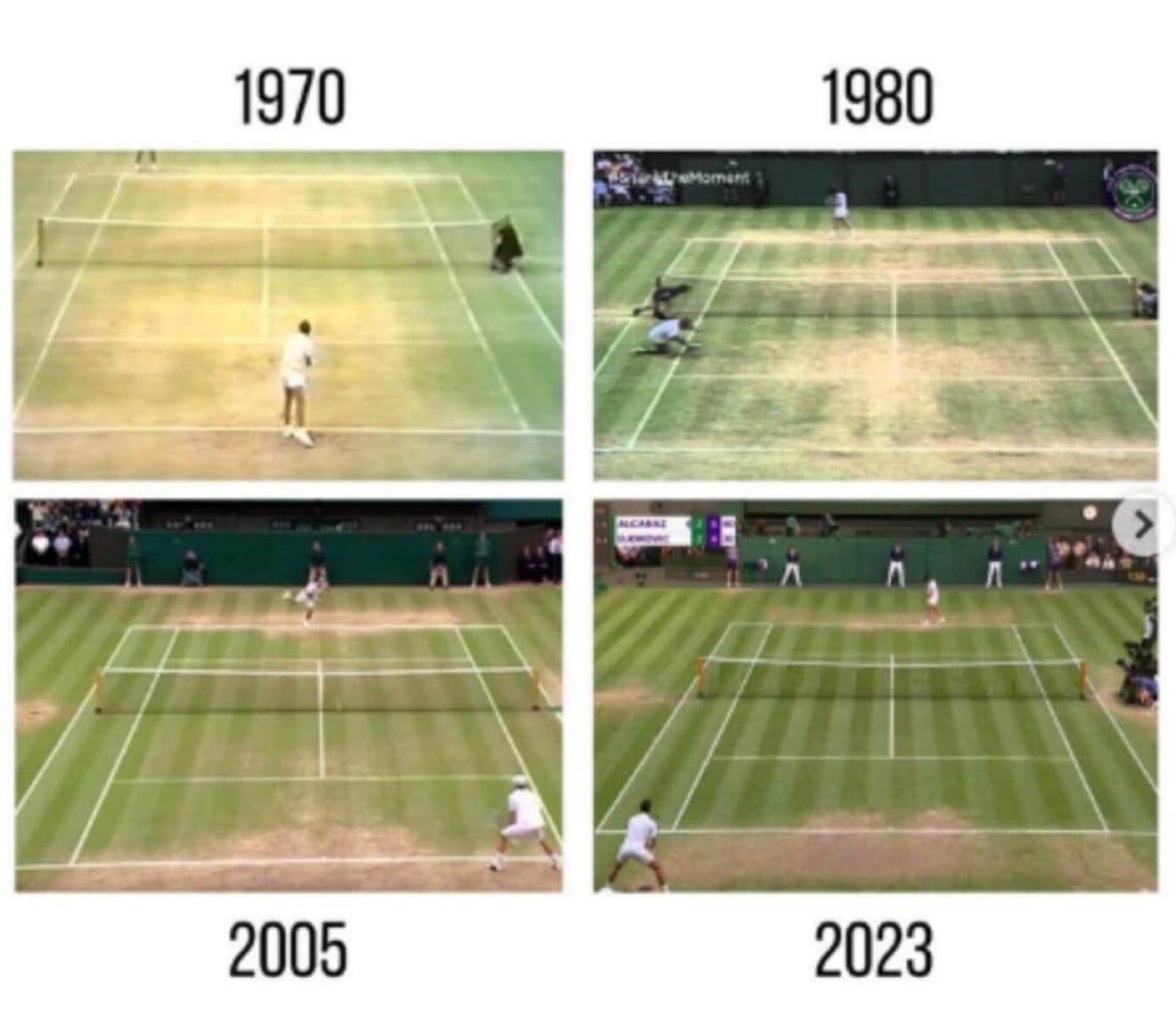
The claim underneath:
the grass wear pattern is an accidental heat map of where players stood. In the 1970s the wear sits up at the net, the serve-and-volley era. By 2023 it has migrated to the baseline, the rally era. “No one designed this dashboard,” the caption said. “Millions of footsteps did.”
It is a lovely observation. It is also a perfect place to practise a skill that matters more every month: telling an emergent signal from a clean story.

The part that is true
The trend is real and well documented. Serve-and-volley points at Wimbledon fell from about a third of all points in 2002 to under one in ten by 2018. The 2001 final was two serve-and-volleyers, Ivanisevic and Rafter. The 2002 final was two baseliners, Hewitt and Nalbandian. Something flipped, and it flipped fast.
So the direction of the story holds. The game moved from the net to the baseline. On that, the grass and the history agree.
The parts that does not survive a second look
The post says no one designed it, that it simply emerged. That is the romantic reading, and it is wrong, it was engineered, on purpose. In 2001 Wimbledon replaced its 70% ryegrass mix with 100% ryegrass on firmer soil, which made the bounce slower, higher and more consistent. At the same time, polyester strings and graphite frames arrived, which let a returner hit a topspin pass that dips at the server’s feet. Rushing the net stopped being brave and started being suicidal. The footsteps did not draw the pattern out of nowhere. They followed the equipment and the surface. There is a mechanism, and we know exactly what it is.
The second problem was spotted by the best comment on the thread, not by the post itself. Are these photos even from the same round? Grass wear depends as much on how deep into the fortnight you are as on the era. A first-round court is fresh. A final is played on two weeks of studmarks. And the baseline wears in every era, because that is where everyone serves and receives. Line up four photos from four different points in four different tournaments and you can make the grass say almost anything you like.
So the post is directionally right and methodologically loose. It is a story, not a measurement. Which is exactly what makes it worth thinking about.
The dashboards no one built
Here is why I did not just scroll past. The good half of that post is a real and underrated idea: your operation is constantly drawing dashboards that nobody designed.
Landscape architects have a name for the grass version: desire paths. The muddy shortcut worn diagonally across a lawn because that is where people actually want to walk, not where the paving told them to. The clever move is not to fence it off. It is to wait, watch where the grass dies, and pave the line people already chose.
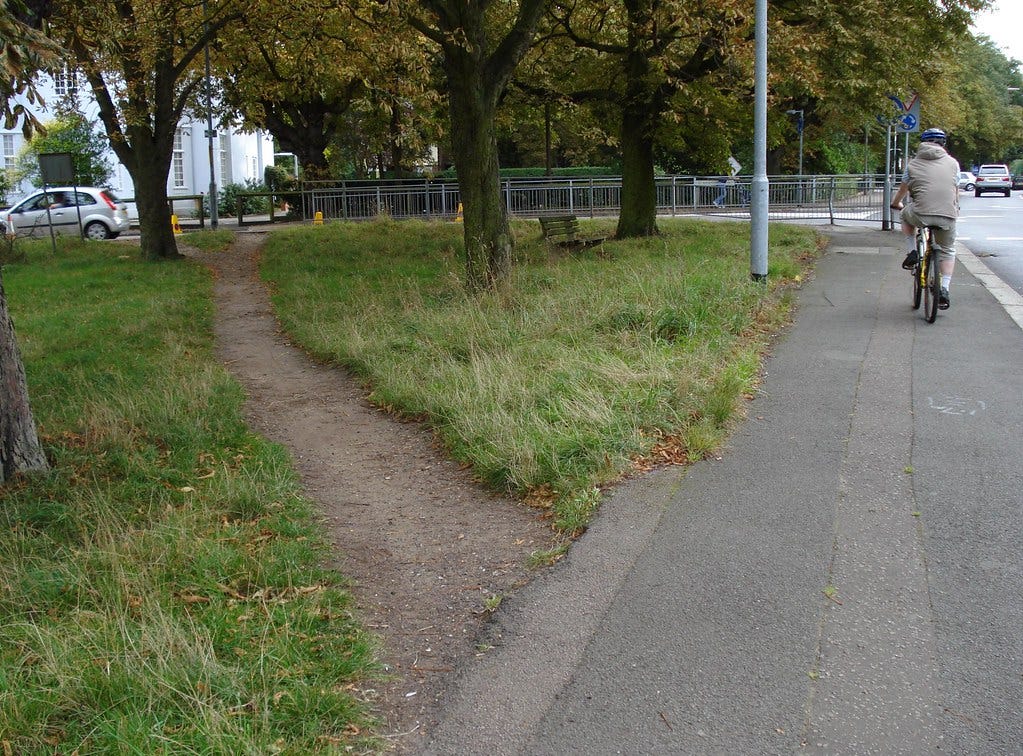
Your business has desire paths everywhere. The support macro your team quietly rewrote because the official one did not work. The one report everyone exports and then edits by hand, which is really a sign the report is wrong. The feature buried three clicks deep that the power users found anyway. The meeting that always overruns, because that is where the real decision gets made. None of it is in a dashboard. All of it is data, worn into the floor by real behaviour, and most of it is more honest than anything in your BI tool, because nobody was performing for it.
The first discipline, then, is simply to look down: read the floor. The truest picture of how your business works is the path people wear when they think nobody is measuring.
Read it like an analyst
The second discipline is the one the grass post skips, and it is the one that separates a good operator from a gullible one. Emergent data is honest, but it is not automatically clean. It is where you find the real signal, and it is also where you get fooled.
The cleanest cautionary tale comes from 1943 aka Survirvorship bias. The American military studied the bombers coming back from raids and mapped where they were riddled with bullet holes: the wings, the fuselage, the tail. The obvious move was to armour those areas. A statistician named Abraham Wald told them to do the opposite. Armour the engines and the cockpit, the places with almost no holes. Why? Because the planes shot there were not in his sample. They did not come back. The data he could see was survivor data, and the gaps in it were the whole point.
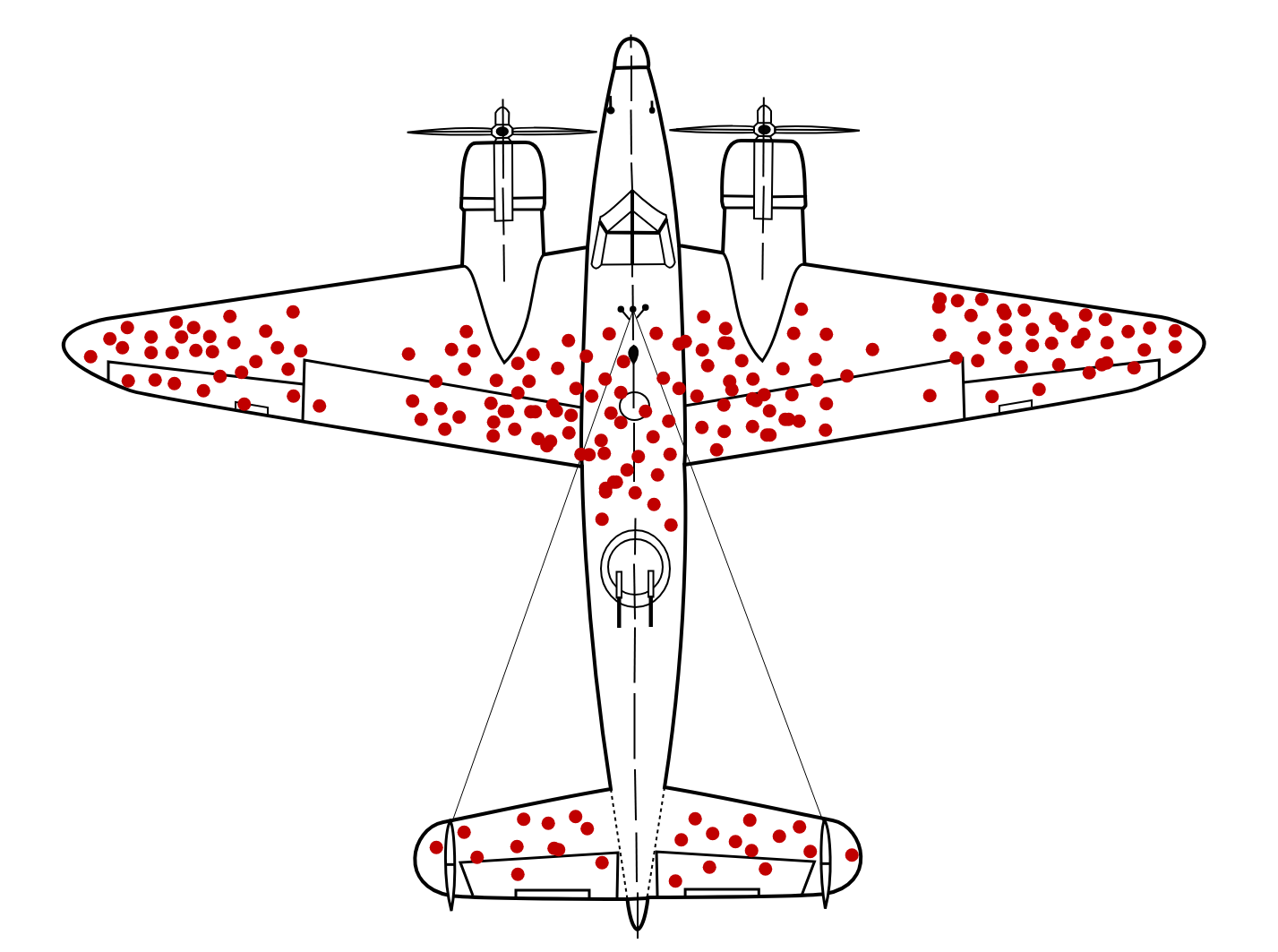
That is the same error as the tennis photos, wearing a different uniform. In both cases the emergent pattern is real. In both cases the naive reading is wrong, because something is missing from the frame. Which round is this. Which planes came home. What else changed at the same time.
So when you find a desire path in your own numbers, hold both thoughts at once. Trust that it is telling you something real. And ask the three boring questions before you build on it. Same conditions? What else changed? Is this the cause, or just the thing I can see?
Why this matters more now, not less
We are about to be buried in clean charts. Ask any model for a visualisation and it will hand you a confident, beautiful, plausible one in seconds, narrative included. The supply of tidy stories is now effectively infinite. The scarce skill is no longer making the chart - in fact it has become “free” with the abundance of data. It is reading the floor for the signal a chart would never think to draw, and then checking which round it is before you trust it.
The best data in your business was not designed. It emerged, in the wear pattern of what people actually do: go and read it. Then, before you pave the path, make sure you are not just looking at the planes that came back.